

Description
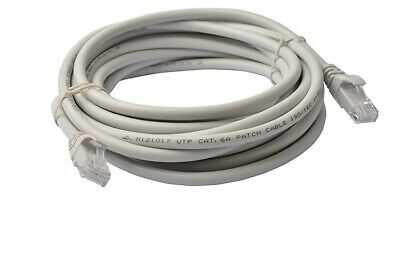
These are Cat-6a which means they are 10 times faster than Cat-5 and Cat-6 and the same speed as the latest Cat-7
- Cat-5e: This form of cable is recognised by the TIA/EIA and is defined in TIA/EIA-568, being last revised in 2001. It has a slightly higher frequency specification that Cat-5 cable as the performance extends up to 125 Mbps.
- Cat-6: This cable is defined in TIA/EIA-568-B provides a significant improvement in performance over Cat5 and Cat 5e. During manufacture Cat 6 cables are more tightly wound than either Cat 5 or Cat 5e and they often have an outer foil or braided shielding. The shielding protects the twisted pairs of wires inside the Ethernet cable, helping to prevent crosstalk and noise interference. Cat-6 cables can technically support speeds up to 10 Gbps, but can only do so for up to 55 metres – even so this makes them relatively long Ethernet cables.
- Cat-6a: The “a” in Cat 6a stands for “Augmented” and the standard was revised in 2008. The Cat 6a cables are able to support twice the maximum bandwidth, and are capable of maintaining higher transmission speeds over longer network cable lengths. Cat 6a cables utilise shielded which is sufficient to all but eliminate crosstalk. However this makes them less flexible than Cat 6 cable.
- Cat-7: This is an informal number for ISO/IEC 11801 Class F cabling. It comprises four individually shielded pairs inside an overall shield. It is aimed at applications where transmission of frequencies up to 600 Mbps is required.
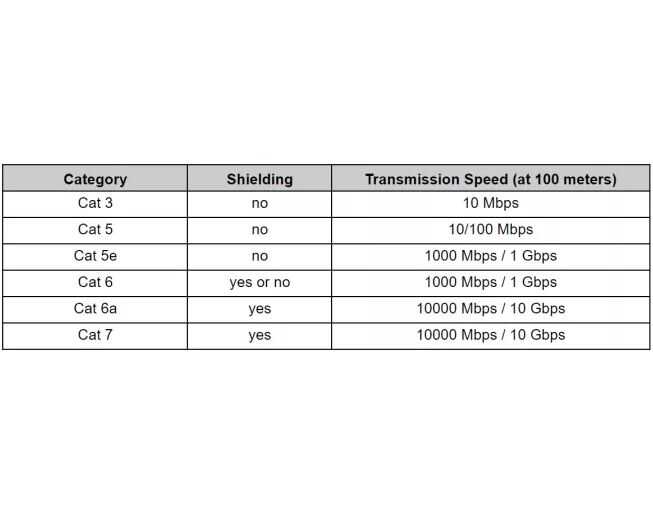
| Cat 3 | Unshielded | 10 Mbps | |
| Cat 5 | Unshielded | 10/100 Mbps | |
| Cat 5e | Unshielded | 1000 Mbps / 1 Gbps | |
| Cat 6 | Shielded or Unshielded | 1000 Mbps / 1 Gbps | |
| Cat 6a | Shielded | 10000 Mbps / 10 Gbps | |
| Cat 7 | Shielded | 10000 Mbps / 10 Gbps |